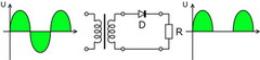
| A half wave rectifier is a special case of a clipper. In half wave rectification, either the positive or negative half of the AC wave is passed easily while the other half is blocked, depending on the polarity of the rectifier. Because only one half of the input waveform reaches the output, it is very inefficient if used for power transfer. Half wave rectification can be achieved with a single diode in a one phase supply. |
 | |  | |  | |  |
| Half-wave rectification |
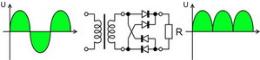
| Full-wave rectification converts both polarities of the input waveform to DC, and is more efficient. However, in a circuit with a non-center tapped transformer, four rectifiers are required instead of the one needed for half-wave rectification. This is due to each output polarity requiring 2 rectifiers each, for example, one for when AC terminal 'X' is positive and one for when AC terminal 'Y' is positive. The other DC output requires exactly the same, resulting in four individual junctions (See semiconductors/diode). Four rectifiers arranged this way are called a bridge rectifier: |
| Full-wave rectification |
| sources cited from Wikipedia, the free encyclopedia @ http://en.wikipedia.org/wiki/Rectifier#Full-wave_rectification |


 Artificial Trees
LED Strings
LED Bulbs
B/O LED Lights
Resources
Artificial Trees
LED Strings
LED Bulbs
B/O LED Lights
Resources